
When Should a Startup Invest in Branding?

Every founder eventually asks when they should invest in branding. The problem is they're usually asking too early or too late.
Timing is responsible for a surprising number of bad branding decisions. We've seen companies spend heavily on formalising a story that was still changing, and we've seen others carry a seed-stage narrative well into Series A because nobody realised it had become a constraint.
The challenge is knowing which stage you're actually in before you start spending money on your startup branding strategy.
Startup branding too early
Most early-stage companies are not ready to invest in a startup branding strategy, despite what the people selling branding might tell you.
Brand work has to be built on a stable position that includes a clear customer, value proposition, and story. Pre-product-market-fit companies don't have any of those things settled by definition.
Data puts the average B2B startup at fourteen months to product-market fit, and most of that time is spent updating who the product is for and what it actually does.
Of course, you can do brand work before that—the issue isn't whether the work can be done. The issue is whether the work survives the next pivot.
Signs you're investing in branding a startup too early
Your messaging is still changing: If the company described in January's deck isn't the same one in April's deck, that's not a problem. It's a sign that you're learning —but brand work tends to last longer when the story has stopped moving quite so quickly.
Your ICP isn't stable: Many startups spend their first year discovering who gets the most value from what they've built. If the answer changes every quarter, there's a good chance the positioning is still finding its feet.
Different people describe the business differently: Ask three people in your business what you do. If you get three very different answers, the business may still be working towards a shared narrative.
The product roadmap is writing the story: Early-stage companies learn through shipping. If every product milestone significantly changes how you describe the business, it may be worth letting the dust settle before formalising the brand around it.
The cost of delaying your startup branding
If the pre-PMF trap is loud and visible, the late trap is quiet.
Most founders don't wake up one morning and realise the brand has become a problem. Instead, the business accumulates small inefficiencies that are easy to dismiss in isolation.
No single issue feels serious enough to justify a branding project but collectively, they become expensive. Research from McKinsey suggests strong brands can improve marketing efficiency by as much as 30%. The inverse is worth considering too.
When the story isn't clear, every team ends up spending more time and money compensating for it.
Signs you've left branding a startup too late
Conversations are getting more complicated: Over time, founders should be answering fewer questions, not more. If every meeting still begins with ten minutes of explanation, it's a sign that the business hasn't found a narrative.
Hiring has gotten harder: In the absence of a clear brand, candidates learn about the company directly from founders and hiring managers. This works well for the first few hires, but becomes harder when the company is trying to scale.
Marketing efficiency has dropped: Most founders assume underperforming marketing is a channel problem. Sometimes it is, but often it's a positioning problem. If the market doesn't understand who your business is for, every campaign has to spend budget teaching the fundamentals first.
The company has outgrown itself: This is probably the most common one. The website, deck, and messaging were all accurate when they were created. But anyone who knew the company a year ago would notice that sales materials are slightly (or very) outdated.
Branding tips for startups: when to brand your business
One of the biggest mistakes founders make is treating branding as a milestone that happens after a funding round, before a launch, or once the company is established enough to justify the spend.
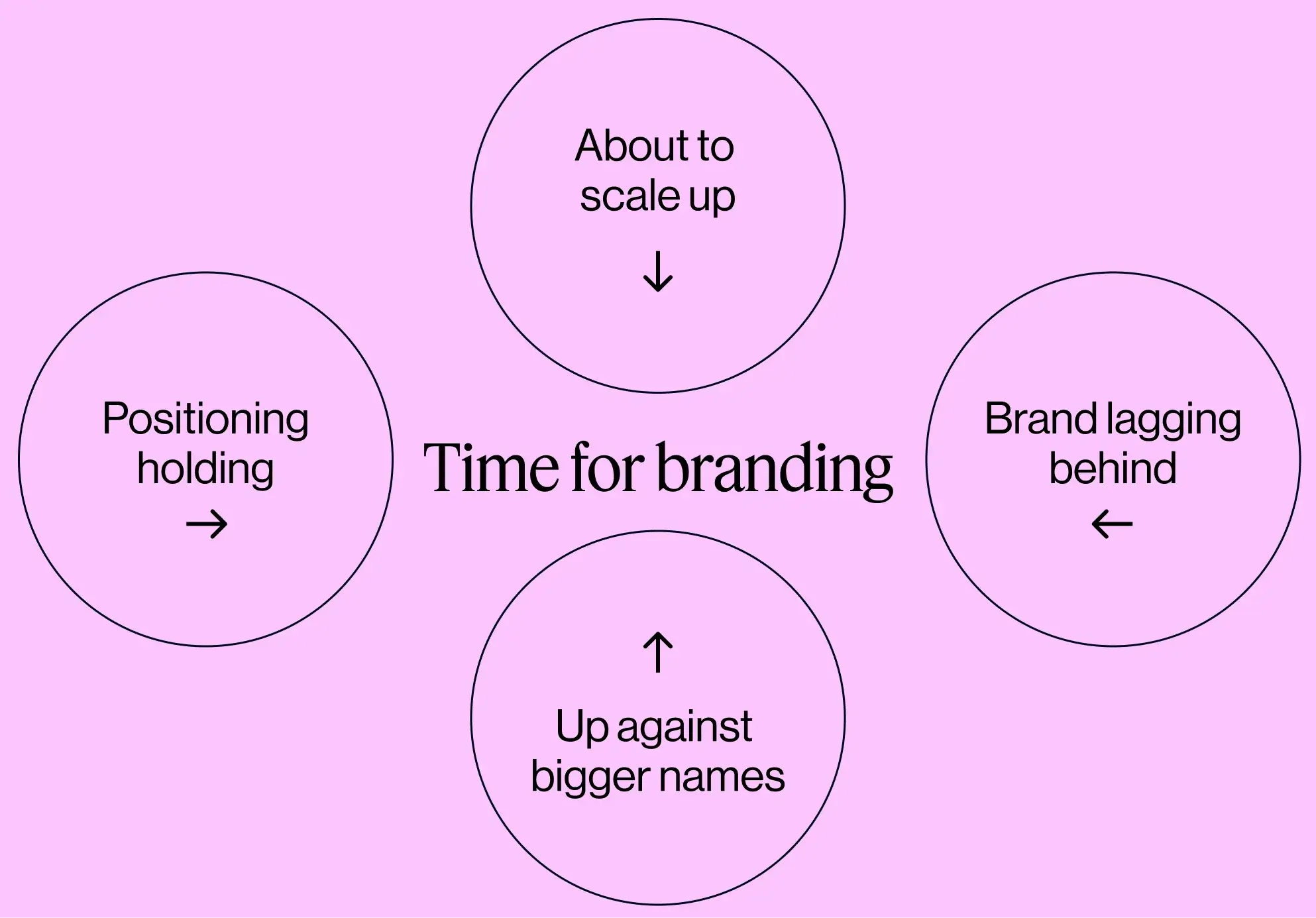
In reality, it’s usually less obvious. We've found there are usually signs that point to the timing being right for a startup branding strategy:
1. Your positioning feels (mostly) consistent
Early-stage companies are supposed to change their minds but eventually, answers should start repeating themselves. That's a sign that the market is giving you evidence—and good startup branding is built on evidence.
Here are a few signals your positioning is beginning to stabilise:
- The customer segment is becoming predictable.
- The same messages keep working.
- Customer interviews or testimonials are producing patterns.
- Your competitor analysis is becoming clearer.
When the fundamentals are in place, it’s a sign that your business is becoming something you can build a brand around.
2. You're about to become more visible
Startup branding becomes significantly more valuable the moment the business starts scaling beyond founder-led growth.
In the early days, the founder was in most calls and meetings. That doesn't last. At some point, the business becomes visible to people who will never meet the founder.
This is where a branding strategy for startups stops being a nice-to-have and starts becoming operational. Here are a few signs you're approaching that stage:
- You're preparing to raise capital.
- You're hiring beyond the founding team.
- You're investing in paid acquisition.
- You're expanding into new markets or customer segments.
- Partnerships and referrals are becoming important growth channels.
The common thread is that communication stops being one-on-one and starts becoming systemic. The companies that best navigate this transition invest in branding before visibility increases.
3. The business has outgrown itself
Startups are busy places, and nobody sets out to create a disconnect between the business and the brand. But before long, the company may evolve while the story around it remains untouched.
Here are a few signs the gap is starting to appear:
- The product solves a more specific problem than the messaging suggests.
- New hires only understand the business after speaking to the team.
- Customers describe the value proposition more clearly than the marketing does.
- The pitch deck, website, and sales materials tell different versions of the story.
What's interesting is that growth often masks the issue. Existing customers, investors, and employees have the benefit of context to help them understand what you do. The people who struggle are the people encountering the company for the first time.
4. You're competing against category leaders
One of the more uncomfortable moments in a startup's journey is realising you're being compared to category leaders.
The prospect evaluating you doesn't necessarily care that you've raised a fraction of the capital, have a team a tenth of the size, or launched three years ago. They're comparing you against the best-known alternative.
That's where startup branding starts becoming strategically useful. It helps you communicate your value more clearly than competitors, many of whom have become accustomed to winning on scale.
A few signs this dynamic is starting to matter:
- Prospects are comparing you against established players rather than direct startup competitors.
- You're increasingly competing in formal procurement, RFP, or evaluation processes.
- The incumbent has stronger brand recognition, but not necessarily a stronger proposition.
- Buyers understand your product once it's explained, but you're struggling to earn initial attention.
- Pricing conversations are becoming more important because you're no longer the low-cost alternative.
Research from Kantar has consistently shown that strong brands command price premiums and outperform weaker brands over time.
The reason isn't particularly mysterious: strong brands reduce the amount of cognitive work required to make a decision. Buyers understand them faster, remember them longer, and feel more comfortable defending their choice.
Branding strategies for startups: what we tell founders
Not every startup needs branding immediately, but every startup eventually needs it.
Part of our job is being honest about where your business is. If it’s too early for a startup branding strategy, we'll say so. It isn't a particularly effective sales tactic, but it's often the right advice.
That said, we're not advocates for waiting until everything is perfectly clear. Founders rarely arrive with a fully formed position, an articulated value proposition, and unanimous agreement across the team.
Our work involves helping businesses make sense of what they've already learned, look for patterns, and stress-test assumptions. Sometimes that leads to a branding project. Sometimes it leads to a recommendation to wait a little longer. Either way, you'll get an honest answer.
If you think the timing may be right for you, book a call.
How do founders know if their positioning is stable enough for branding?
Can a startup invest in branding too early?
What are the signs a startup has waited too long to invest in branding?
Does branding become more important as a startup grows?
Can branding help startups compete against larger companies?
Is branding just about logos and visual identity?