
Brand Identity vs. Brand Strategy: What’s the Difference and Why It Matters

Founders are building fast with tight budgets, and often cut anything that slows the path to launch. So when momentum builds, most dive straight into execution without taking the time to define their brand, story, or strategy.
It’s a common shortcut in small business branding, and the urgency is understandable. But when speed overrides strategy, it can come at the expense of long-term value.
That’s why it helps to pause and ask: what does your brand really need right now? Sometimes, a strong brand identity is enough to launch. Other times, you need strategy first. In most cases, the two work best together.
In this article, we’ll break down how brand strategy and brand identity differ, and why doing them in the right order saves time and money as you grow.
Firstly, what is a brand?
It sounds obvious but when you actually ask, you’ll hear answers like a logo, a product, a name, or a vibe. Those are parts of a brand, but they’re not the whole picture.
A brand is the sum of how your business is perceived by everyone who interacts with it. It’s shaped by how you speak, how you look, what you say, and how consistently you do it over time. It’s built across every touchpoint, whether intentional or not.
So yes, a brand includes your identity and messaging. But it’s also shaped by strategy, which guides everything from your onboarding emails to your founder’s LinkedIn bio.
At its best, a brand system brings cohesion to how you show up and what you stand for. But when it’s not working, the gaps start to show and your brand can feel confusing, forgettable , or even unprofessional.
How your brand strategy sets the rules

A brand strategy framework is the thinking that defines your purpose, brand positioning, audience, and guides how your business shows up. It’s your “how” and “why”.
Still, a lot of founders hesitate when they hear “brand strategy.” It can sound slow or slightly abstract. When you're trying to launch, raise, or pivot, going back to the core of your brand can feel like a detour.
But in practice, a brand strategy is one of the most useful tools an early-stage business can invest in. In our work, we’ve seen what happens when it’s skipped. Teams move fast, but not necessarily in the same direction. The brand identity gets built on shaky ground. Then, somewhere down the line, comes a moment of realisation that you don’t know what your brand is saying or why it matters.
Brand strategy solves that by giving you a central narrative that guides how you speak, what you prioritise, and how others experience what you’re building. Here’s what it usually includes:
- Purpose: Why your brand exists beyond the product
- Vision: Where you’re going
- Mission: How you’ll get there, day to day
- Audience: Who you’re speaking to, what they need, and how they think
- Positioning: What makes you different and why it matters
- Value proposition: The clearest articulation of your offer
- Brand personality: The human traits that define your tone and behaviour
- Tone of voice: How your brand sounds across channels
- Messaging pillars: What you talk about and when
When you have this foundation, your team has a shared reference point that guides creative decisions, anchors internal discussions, and keeps your brand consistent even as your team evolves and your business scales.
Case study: Final Rentals
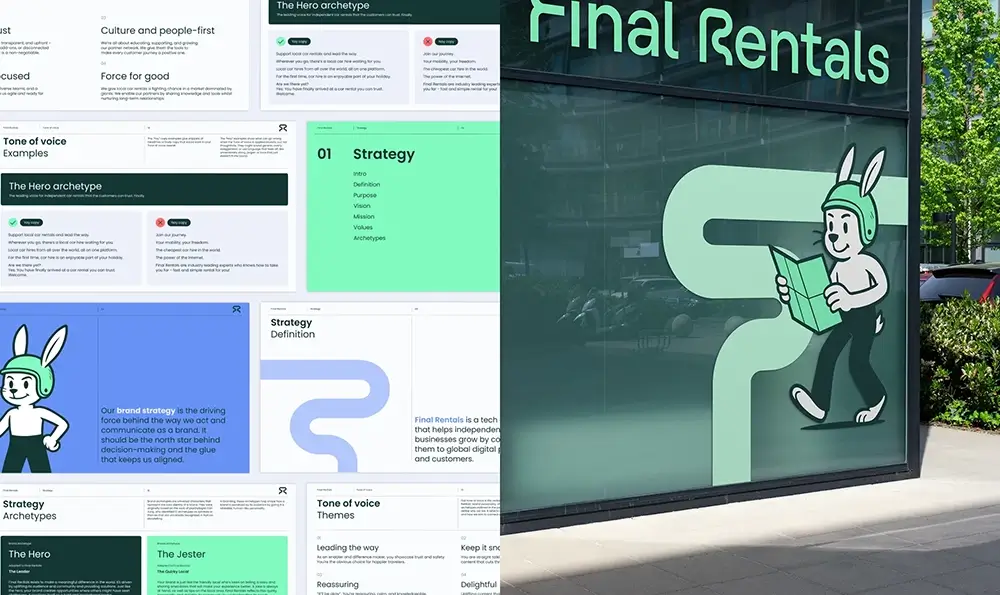
The car rental space is cluttered, and brands rely heavily on generic visuals and transactional language. It’s an industry with little differentiation and even less personality.
Final Rentals is a platform with a tech-first mindset and a mission to make car rentals simpler for travellers and more sustainable for local operators. The brand needed to communicate warmth without sacrificing credibility, and reflect a people-first experience powered by smart systems.
When working with them, we saw an opportunity to stand out with an approach that balances playfulness with authority. Their brand identity and mascot emerged naturally from this thinking as functional assets to carry tone, drive recall, and build emotional connection across diverse markets.
This is what brand strategy unlocks: a brand that moves fast, stands out, and grows without losing its shape.
Brand identity brings strategy to life
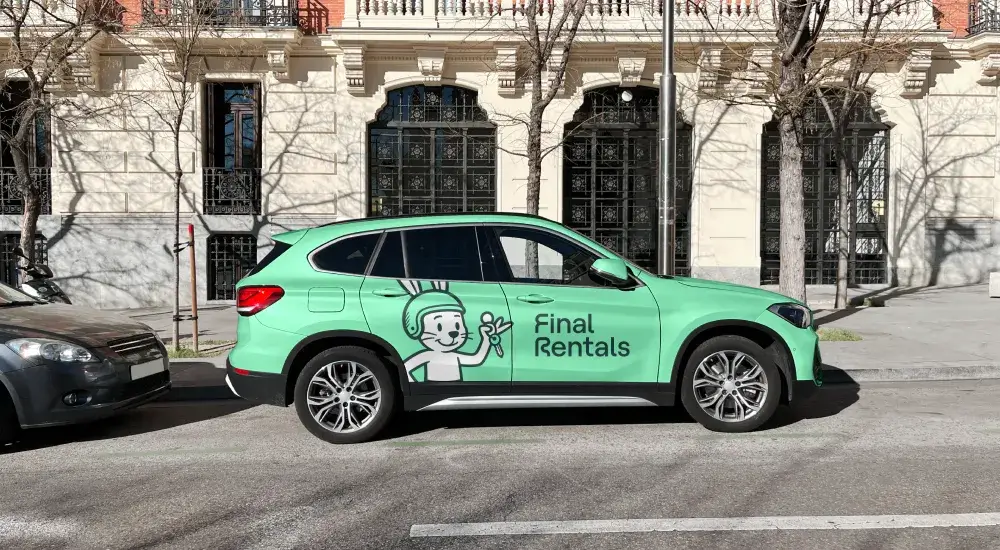
If brand strategy is the thinking, brand identity is the expression. With the foundation in place, it’s time to start thinking about how your brand looks, sounds, and feels in the real world.
Our brand identity bundle typically includes:
- Logo design
- Colour palette
- Typeface selection
- Illustration
- Graphic system
- Brand guidelines
- Templates
- Animation
- Photoshoot
Each of these elements is guided by your brand strategy so they’re not just visually cohesive, but strategically aligned. When your brand identity is built this way, it becomes a scalable system that your team can apply at speed across touchpoints.
Build your brand from the inside out
The strongest brands don’t start with visuals alone. They’re built on strategy.
If you already have a clear direction, we’ll help you bring it to life through a new or refreshed brand identity. If that direction still needs shaping, our full brand identity package gives you both, along with a full website build and ongoing support.
At Immo Studio, we’re a branding agency that helps start-ups and scale-ups build brands that go beyond good design. Whether you’re launching something new, entering a new chapter, or circling back to fix what didn’t land the first time, we develop strategic branding that reflects where you are and where you’re going.
What is the difference between brand strategy and brand identity?
Why should you develop a brand strategy before a brand identity?
Can a business have a brand identity without a brand strategy?
What are the essential components of a brand strategy framework?
What does a comprehensive brand identity package include?
Can a startup launch with only a brand identity?
How does a strong brand identity impact business growth?