
Choosing a Webflow Development Agency: Why We Build on Webflow

Maybe you’re building a new website from scratch. Or perhaps your current one has made a simple headline update feel painfully similar to filing a tax return.
No matter what industry you’re in, your website evolves over time. The best platform is one that allows that to happen with the least amount of friction. For most businesses, that platform is Webflow.
We’ve used WordPress, explored newer platforms, and worked with clients at very different stages of growth. Time and again, Webflow has proved to be the most practical option.
This isn’t a platform comparison piece, at least not in the usual sense. It’s a look at why we build on Webflow, when WordPress is still the right choice, and what matters when you’re choosing a Webflow development agency.
Why we build (nearly) everything in Webflow
Like most design studios, we spent some time exploring Framer when enthusiasm around it was at its peak.
To be fair, it is a beautifully made product. But after testing it on real projects, it felt a little like being handed a toy car after years of driving the real thing. Framer is excellent for personal portfolios, landing pages, and fast experiments. For more substantial websites, it still feels too lightweight.
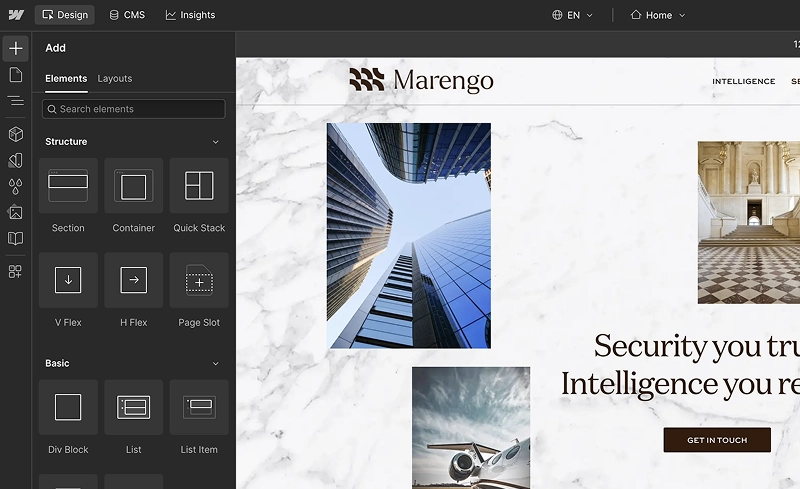
On a practical level, Webflow gives us everything we need. We have full control over the design, the code output is clean, and the CMS is intuitive enough that clients can update their own content after the site is live.
It also keeps ongoing website maintenance to a minimum. There are no plugins to update, no compatibility issues to investigate, and far fewer emails that begin with someone forwarding an error message.
There’s also a less technical reason we prefer it: Webflow is simply a well-designed piece of software. The interface is thoughtful, the logic is clear, and it feels like a tool built by people who care about design.
As a strategy and design-led studio, the tools we use shape the way we work, and Webflow aligns naturally with how we think about structure, detail, and visual precision.
.webp)
Why Webflow works well for SaaS & small business websites
I’m clearly fond of Webflow, but I wouldn’t keep recommending it if it didn’t make life easier for our clients.
In practice, it tends to be an especially good fit for two types of businesses: SaaS companies and service-based small businesses and scale-ups. They’re very different, but both need websites that can evolve without creating technical headaches down the line.
SaaS website design
In SaaS, one thing becomes obvious very quickly: the website is never really “finished”.
Product features evolve, pricing moves, positioning sharpens, and the website expands as new campaigns and use cases emerge. The website is also often doing several jobs at once: it needs to explain the product, support sales conversations, reassure investors, and convert users.
Webflow handles this environment exceptionally well. Its CMS makes it easy to build and manage feature pages, comparison pages,and resource libraries, while giving teams the freedom to update content without needing to involve a developer for every small change.
Small business website design
Webflow is equally well suited to small business web design.
For consultancies, architecture practices, and other service-based businesses, the website needs to look credible, communicate clearly, and be easy to update without becoming a full technical side project.
Webflow offers the perfect balance of design quality, simplicity, and operational control for businesses investing in small business web design. It allows teams to make changes quickly and keeps the technical infrastructure largely invisible.
Which, for most business owners, is exactly how technology should behave.
Webflow or Wordpress?
Clients often ask me whether Webflow is better than WordPress, usually in the tone of someone who would quite like a definitive answer. The slightly unsatisfying truth is that both are excellent platforms.
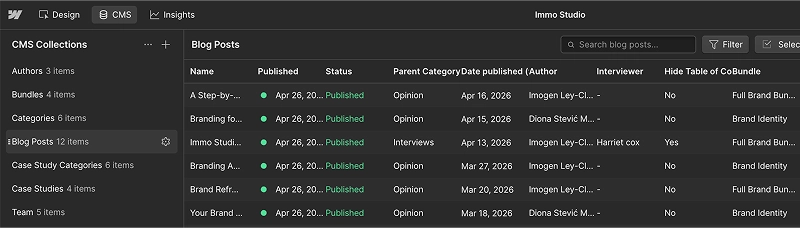
WordPress powers a huge portion of the internet for good reason. It’s widely supported, highly extensible, and capable of handling extremely complex websites. Its CMS is also more powerful than Webflow’s, particularly when it comes to sophisticated content structures, advanced filtering, and editorial workflows at scale.
If a client comes to us with a large WordPress site, years of content, and a setup that’s working perfectly well, I’m not going to suggest rebuilding it in Webflow simply because I happen to like it more.
WordPress can do almost anything, but the trade-off is that it asks more of you in return. Plugins need updating, security requires monitoring, and the occasional issue appears without warning and with no regard for your schedule. But if you have an on-call developer or your business genuinely has complex requirements, WordPress is incredibly valuable.
For most businesses, that level of complexity is unnecessary.
It all comes down to what your business needs and how much technical overhead you can manage once the site is live. Sometimes the answer is actually WordPress. More often than not, it’s Webflow.
Good websites aren’t built by a platform
No matter which platform you use, a good website is built through understanding what the business needs to communicate and how users are expected to move through the site.
Before we begin building, we work through positioning, messaging, information architecture, and content strategy. We want to know what the site needs to say, what questions it should answer, and what actions it should encourage—if those answers aren’t fully defined, that’s part of the work we do with our clients.
This is one of the main differences between build-focused Webflow agencies and studios like ours. Many are highly capable from a technical perspective, and there’s no shortage of talented Webflow experts who can build beautifully on the platform.
But technical execution is only part of the job. If the brand foundations aren’t in place, even the most polished build will still be a very elegant way of saying very little.
At Immo Studio, we’re a web design business that leads with thinking. We believe the most effective websites are strategically considered before a single component is built, and the platform is simply the framework that supports that thinking.
Why do many businesses choose Webflow over WordPress?
Is Webflow good for SaaS website design?
Does Webflow work well for small business website design?
When is WordPress still the better choice?
What should businesses look for in a Webflow development agency?
Does choosing Webflow reduce website maintenance?